
Built for Indian equity markets. Powered for American ones.

From Data to Decision. In Minutes, Not Weeks.

The AI research platform that builds DCF models from BSE/NSE filings, pulls 3-statement financials from SEC EDGAR, and gives you a position you can stand behind. The markets Bloomberg underserves, finally covered.

Research isn't the goal. Conviction is.

Most analysts spend 70% of their week on data extraction, not thinking. We built the tool that eliminates that work—upload a filing, get a DCF model, ask the chatbot anything, and walk away with a position you can defend.

What changes when you have conviction

Bloomberg and Capital IQ were built for Wall Street. We built from the ground up for BSE and NSE—and added the US equity analysis Bloomberg charges $25K/year for.

2 weeks → minutes
DCF modeling time for Indian equities
10-K → thesis
End-to-end: from filing to structured investment analysis
Indian-first
BSE/NSE coverage Bloomberg and Capital IQ leave open
20+ companies
Validated at 94.8% accuracy vs. audited models

The only AI research platform built natively for Indian equities—with a full US analysis terminal.

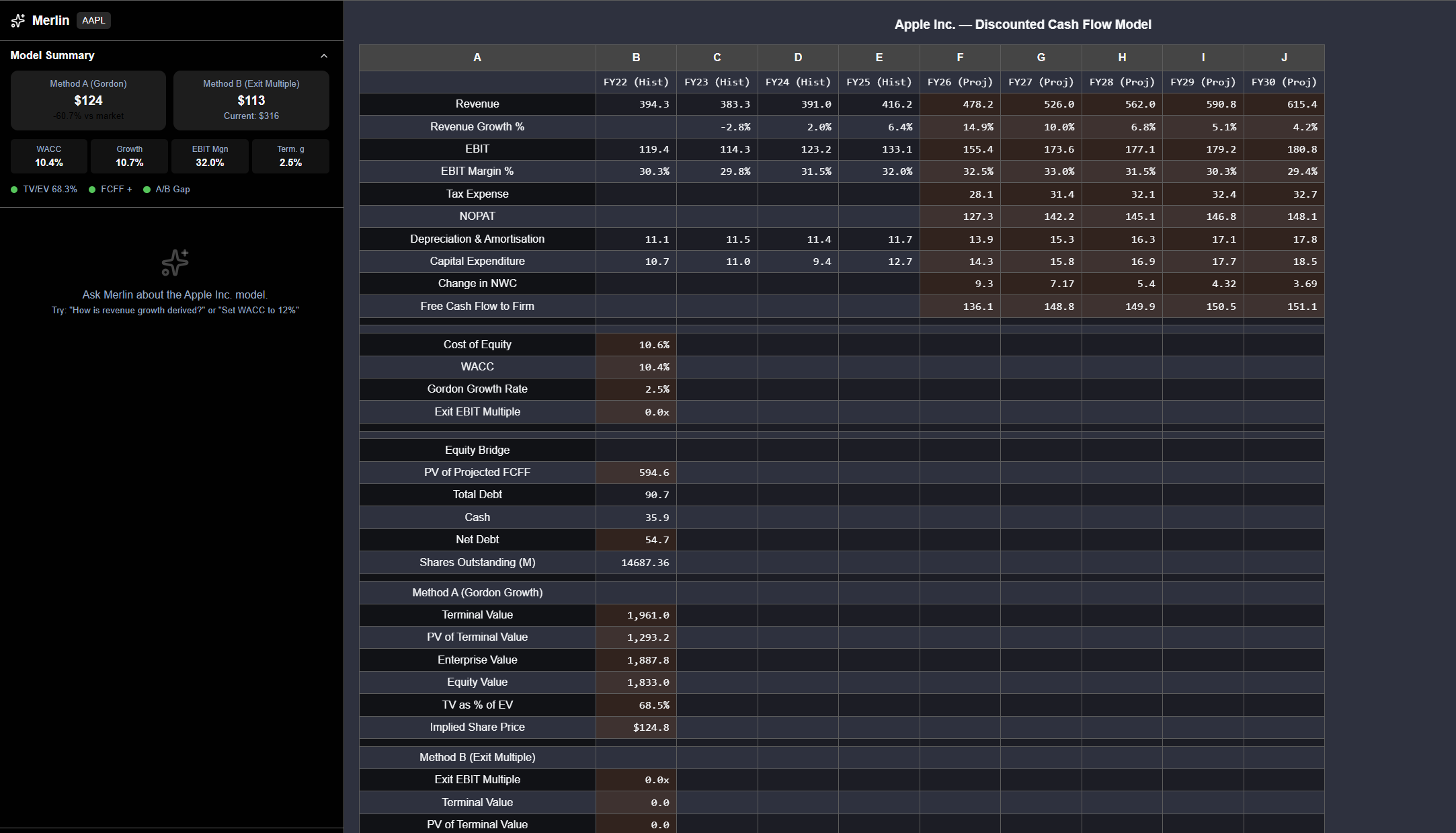
DCF valuations from BSE/NSE filings. 3-statement models from SEC EDGAR. Earnings intelligence and document extraction. Every output traceable to source. The conviction gap Bloomberg left open, closed.

Indian DCF Pipeline

The market Bloomberg left open

  • Upload BSE/NSE filings and get a full DCF valuation model in minutes
  • 4-tab Excel output: Financials, Assumptions, DCF Model, Sensitivity
  • Two valuation methods: Gordon growth + exit multiple
  • Edit any assumption live: WACC, growth rates, margins, terminal value
  • 20+ companies validated at 94.8% accuracy vs. audited models
  • The first AI tool built natively for Indian equity research

US Analysis Terminal

SEC EDGAR, automated

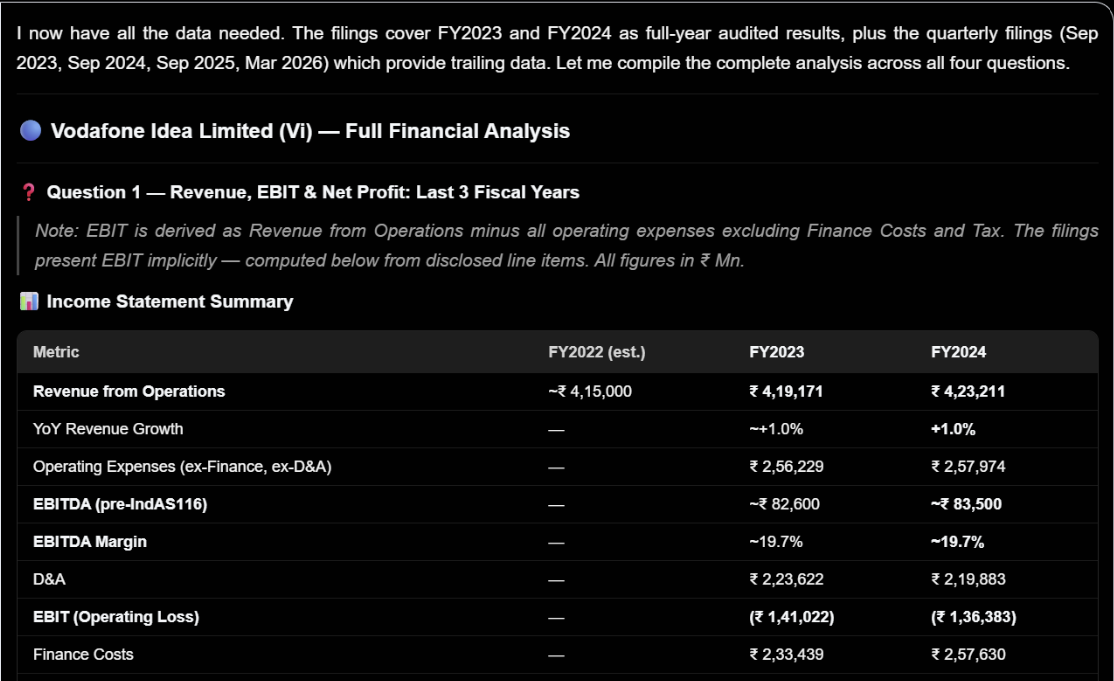
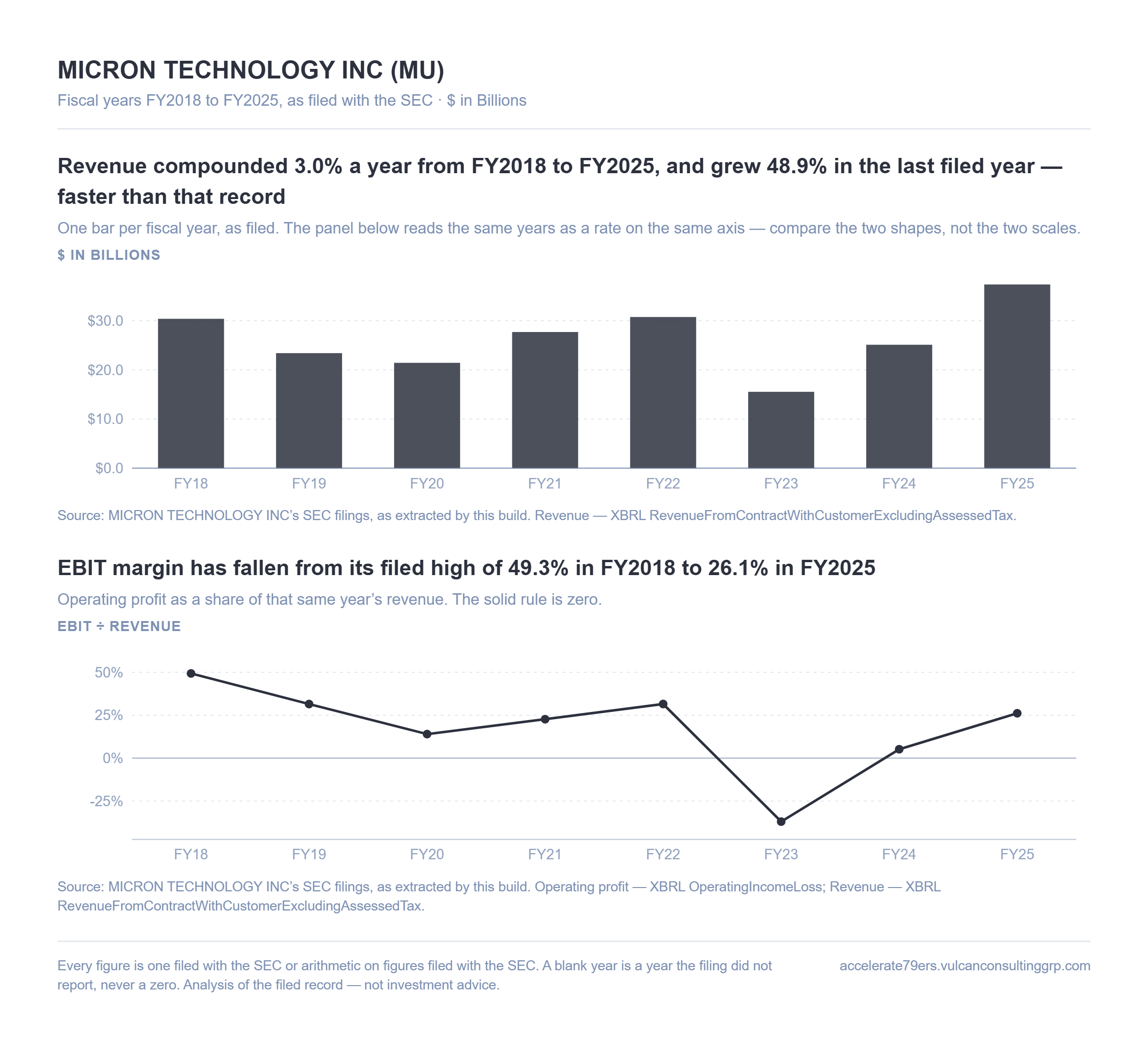
  • 3-statement models (IS, BS, CF) from SEC EDGAR for any US-listed company
  • Annual and quarterly financials, up to 5 years of history
  • Structured Excel workbook export
  • Real-time stock quotes: price, P/E, market cap, 52-week range
  • The same financial data Wall Street uses—without the terminal cost

Document Intelligence

Ask anything, get sourced answers

  • Upload any PDF—annual reports, quarterly filings, pitch decks, CIMs
  • Multi-tier extraction: AI reads tables, charts, and text automatically
  • Ask questions about the document and get sourced answers
  • Real-time stock quotes: price, P/E, market cap, 52-week range
  • Live web search for breaking news, analyst estimates, and macro data

Earnings Intelligence

Transcript-level sentiment analysis

  • Sentiment analysis on any public company earnings call
  • CEO vs. CFO tone breakdown with scores
  • Analyst-by-analyst Q&A memo with firm attribution
  • Management guidance extracted with verbatim quotes
  • Key risks, themes, and divergences surfaced automatically

How it works

Step 1 — Upload

Drop in any 10-K, 10-Q, earnings transcript, BSE/NSE filing, or enter a ticker. Indian or American—the platform handles both.

Step 2 — Analyze

Structured data extracted automatically. DCF model built from the numbers inside. 3-statement financials pulled from SEC EDGAR. All exported to Excel.

Step 3 — Question

Ask the chatbot anything—qualitative or quantitative—and get sourced, in-document answers. Edit assumptions live. Test your thesis before committee.

Step 4 — Decide

Walk away with a position you can defend. Not a summary. Not a chart. A conviction.

Upload a filing. Get a DCF model. Ask the chatbot anything. Walk away with a position you can defend.

Why not just use Bloomberg or ChatGPT?

Bloomberg

$25,000+/year. Doesn't cover Indian equities.

ChatGPT

Summarizes filings. Can't build a model from one.

Accelerate 79ers

Indian DCF + US financials + earnings intelligence. Under $30/mo. Every number sourced.

Two markets. One platform.

Your analysts are smart. They just spend most of their day doing work that isn't thinking. Whether you manage a fund in Mumbai or invest your own money in New York—the conviction gap is the same.

For Indian Asset ManagersB2B
Upload BSE/NSE filings and get a DCF model in minutes—not weeks. Edit assumptions live, interrogate the chatbot, and walk into IC with a position you can defend. The Bloomberg gap in Indian equity research, closed.
For North American AnalystsB2B
Pull 3-statement models from SEC EDGAR, run earnings sentiment analysis, and extract data from CIMs and filings. Cover more companies with the same headcount. Find the non-consensus call Bloomberg misses.
For Retail InvestorsB2C
Most investors know what they believe. They don't know how to prove it. The same analysis the pros use, built for the investor you're becoming—no terminal required. Stop guessing. Start researching.

What Makes Vulcan Consulting Group Different

Every competitor stops at insight. We begin there.

Bloomberg, Capital IQ, and every AI research tool is built to deliver data and analysis. They stop at insight. We own the space between insight and decision—the conviction gap. Indian equities with native BSE/NSE coverage. American equities with automated SEC EDGAR analysis. One platform, every output traceable back to its source.

Indian-First

The first AI research platform built natively for BSE/NSE-listed companies. The coverage gap Bloomberg and Capital IQ left open, filled.

Every Output Traceable

Every assumption, line item, and data source links back to the filing. Audit-ready. No black boxes. No hallucinated numbers.

Conviction, Not Just Analysis

We don't stop at insight. Upload a filing, build a model, interrogate assumptions, and walk away with a position you can defend.

What You Can Do

Indian DCF Valuations

Upload BSE/NSE filings and get a full DCF valuation—two methods (Gordon growth + exit multiple), sensitivity tables, editable assumptions, and Excel export. 20+ companies validated at 94.8% accuracy.

US 3-Statement Models

Pull full income statement, balance sheet, and cash flow from SEC EDGAR for any US-listed company. Annual and quarterly, up to 5 years of history. Structured Excel export.

Document Q&A

Upload any PDF—annual reports, pitch decks, CIMs—and ask questions. AI extracts tables, figures, and text with sourced answers.

Live Market Data

Real-time stock quotes, P/E, market cap, 52-week ranges. Live web search for breaking news, analyst estimates, and macro data.

Earnings Intelligence

Sentiment analysis on any earnings call. CEO vs. CFO tone, analyst Q&A memos, management guidance with verbatim quotes—all sourced to the transcript.

About Vulcan Consulting Group

We believe the most valuable thing in finance isn't information—it's the courage to act on it. Vulcan was founded to close the gap between data and decision. Indian markets deserve the same analytical infrastructure Wall Street takes for granted. Every investor deserves tools built for the decision, not just the data. This is the Conviction Movement.

The Conviction Platform

Purpose-built for Indian asset managers, North American analysts, and retail investors who need to move from filing to thesis—fast.

Research

2025 Financial Modeling Efficiency Survey

Analysts and investment bankers are spending too much time on mechanical work—and still catching errors late. Here’s what 12 finance professionals reported as the biggest modeling bottlenecks.

41.7%
Spend 30+ hours/week on modeling
66.7%
Spend 26–50% of model time on low‑value mechanical tasks
58.3%
Find errors frequently after sharing/presenting
83.3%
Have experienced excessive overtime/weekend work due to model issues

Where time disappears

  • Updating existing models (58.3%)
  • Gathering & importing financials (50%)
  • Formatting & standardization (50%)
  • Building formulas & calculations (50%)
  • Researching comparables (50%)
  • Error-checking & validation (50%)

Takeaway: the bottleneck isn’t “analysis”—it’s rebuilding the same structures under time pressure.

What breaks (and what teams want automated)

  • Linking/reference errors are most common (75%)
  • Formula errors (50%) and data entry errors (50%) remain frequent
  • Top automation targets: initial model setup/formatting (75%) and model updates (58.3%)
  • Top AI concerns: accuracy (83.3%), then security (33.3%) and explainability (33.3%)

This is why Vulcan focuses on accuracy with transparent, reviewable outputs—so analysts can move faster without losing control.

Research & Insights

Earnings-call intelligence and future research updates from Vulcan Consulting Group. The featured analyses below were produced with Accelerate 79ers.

More company updates and research will be posted here as they are available.

Earnings-call intelligence

Entegris (ENTG), Q4 2025 — transcript-derived signals. Source: Motley Fool earnings call transcript (published Feb 10, 2026). Analysis refreshed April 2026. Speaker identification confidence 83.1%. Produced with Accelerate 79ers.

Sample platform output. For informational purposes only. Vulcan Consulting Group is not a registered investment advisor.

How to read the scores: “Management” FinBERT averages all executive speakers on the call. CEO and CFO scores are sentence-level FinBERT for those roles only—so the headline CEO vs. CFO spread (0.26 vs. 0.05) can differ from the blended management average (0.22).

0.22 Mgmt. FinBERT avg. (−1 to +1)
0.18 Analyst FinBERT avg.
+0.32 Loughran–McDonald (mgmt.)
0.21 CEO vs. CFO FinBERT gap
83.1% Speaker ID confidence

Takeaway

Management averages 0.22 on FinBERT with LM polarity +0.32. Positive lexicon leans on words like good, benefit, and strong; negatives include decline and operational challenges. Themes: growth expectations, advanced logic transitions, memory market recovery, and margin improvement.

Analyst sentiment averages 0.18—directionally aligned with management but more subdued than the CEO’s optimism (NAND recovery, margin trajectory, content growth, memory shortage impacts, positioning in China).

CEO vs. CFO: David Reeder (302 sentences, ~64% of scored content) scores 0.26 on FinBERT; Linda LaGorga (63 sentences) scores 0.05—a 0.21 spread. The CEO balances near-term challenges with optimism on memory stabilization and execution; the CFO emphasizes ramp costs, volume, and margin mechanics.

High-frequency terms (sample)

015304560
growth
revenue
market
memory
margin
capex
growth39
revenue33
market33
customers20
AI11
margins2

LM positive words

strong
able
improving
benefit

LM negative words

rationalize
shortages
closing
decline

Speaker highlights (excerpt)

CEO
Execution & cash

FCF margin

Context

“Thanks to the team’s execution, free cash flow margin… improved meaningfully reaching 12.7% in 2025 in line with our target.”

CEO
CapEx-linked revenue

Down 7% YoY

Context

“Our CapEx-driven revenue declined 7% in 2025, consistent with the decline in industry fab construction CapEx.”

CFO
Advanced Purity Solutions

$465M · Q4

Context

“Sales for Advanced Purity Solutions in Q4 were $465 million down 5% year on year…”

Methodology: Accelerate 79ers was used for this analysis. FinBERT (financial sentiment); Loughran–McDonald dictionary (positive % minus negative % of financial words). Source: public earnings call transcript (third-party publisher named above).

Back to Research & Insights

Earnings-call intelligence

Microsoft (MSFT), Q2 FY26 — transcript-derived signals. Source: public earnings call transcript. Analysis refreshed April 2026. Speaker identification confidence 83%. Produced with Accelerate 79ers.

Sample platform output. For informational purposes only. Vulcan Consulting Group is not a registered investment advisor.

How to read the scores: “Management” FinBERT averages executive speakers on the call. Analyst scores aggregate sell-side question-and-answer turns—so the management vs. analyst spread (0.25 vs. 0.12) reflects tone differences between the prepared remarks / exec Q&A and the street’s framing.

0.25 Mgmt. FinBERT avg. (−1 to +1)
0.12 Analyst FinBERT avg.
+0.56 Loughran–McDonald (mgmt.)
−0.07 CEO vs. CFO FinBERT gap
83% Speaker ID confidence

Takeaway

Management averages 0.25 on FinBERT with LM polarity +0.56—a constructive lexicon tilt on cloud scale, AI attach, and operating leverage. Positive mentions cluster around growth, demand, and opportunity; negatives include FX, capacity, and discipline on spend.

Analyst sentiment averages 0.12, more measured than management’s prepared tone—consistent with a sell side testing ramp economics, Azure consumption cadence, and Copilot monetization paths.

CEO vs. CFO: Satya Nadella (exec remarks + leadership Q&A) scores slightly below Amy Hood on FinBERT in this pass—a −0.07 spread—suggesting broadly aligned messaging with the CFO leaning into guidance mechanics, margin guardrails, and segment mix.

High-frequency terms (sample)

020406080
cloud
Azure
AI
revenue
Copilot
growth
cloud47
Azure41
AI36
Copilot22
revenue28
customers19

LM positive words

growth
strong
opportunity
demand

LM negative words

FX
headwinds
capex
uncertainty

Speaker highlights (excerpt)

CEO
AI & platform

Copilot + Azure

Context

“We’re seeing AI workloads move from experimentation to production—and that shift shows up across Azure, data, and developer tools.”

CEO
Cloud demand

Consumption

Context

“Customer conversations are increasingly about scaling safely: governance, security, and ROI on AI spend—not just pilots.”

CFO
Outlook

Revenue + margin

Context

“We’re balancing growth investments with disciplined operating leverage—and we’ll update segment mix as the year progresses.”

Methodology: Accelerate 79ers was used for this analysis. FinBERT (financial sentiment); Loughran–McDonald dictionary (positive % minus negative % of financial words). Source: public earnings call transcript.

Back to Research & Insights

Earnings-call intelligence

Apple (AAPL), Q1 2026 — transcript-derived signals. Source: Motley Fool earnings call transcript (call Jan 29, 2026). Analysis refreshed April 2026 (data scraped April 16, 2026). Speaker identification confidence 77%. Produced with Accelerate 79ers.

Sample platform output. For informational purposes only. Vulcan Consulting Group is not a registered investment advisor.

How to read the scores: “Management” FinBERT averages executive speakers on the call. CEO and CFO scores are sentence-level FinBERT for those roles only—so the headline spread (0.37 vs. 0.40) can differ from the blended management average (0.36).

0.36 Mgmt. FinBERT avg. (−1 to +1)
0.07 Analyst FinBERT avg.
+0.61 Loughran–McDonald (mgmt.)
0.03 CEO vs. CFO FinBERT gap
77% Speaker ID confidence

Takeaway

Management averages 0.36 on FinBERT with LM polarity +0.61. Positive lexicon leans on words like strong, best, and excited. Key themes: record iPhone revenue, strong performance in China and India, and robust services growth.

CEO — Timothy Cook: 181 scored sentences at FinBERT 0.37. Highlights include a best-ever quarter at $143.8 billion in revenue (up 16% YoY), 38% growth in China, momentum in emerging markets (including India), Apple TV viewership gains, and an expanding installed base. Supply-chain constraints and very lean channel inventory from strong demand appear as recurring negatives in commentary.

CFO — Kevan Parekh: 125 sentences at FinBERT 0.40. Commentary emphasizes iPhone revenue at $85.3 billion (up 23% YoY, iPhone 17 family), products gross margin 40.7% (up 450 bps sequentially), and March-quarter revenue guidance of 13–16% YoY growth. Mac revenue at $8.4 billion (down 7% YoY) surfaces category pressure alongside strength elsewhere.

Alignment: CEO and CFO scores sit within 0.03 on FinBERT (Cook 0.37 vs. Parekh 0.40). Messaging stays unified on iPhone, services, and international expansion; the CFO carries more of the explicit category-level declines (Mac, wearables) in the prepared commentary.

Analyst sentiment

Analysts average 0.07 on FinBERT—materially more neutral than management’s 0.36. Question-and-answer turns skew factual and probing rather than celebratory. Standout positive mentions include an “encouraging” revenue outlook (Michael Ng) and commentary that services and services margins are improving (Ben Reitzes). Pressed topics include memory pricing, App Store growth deceleration, and AI monetization timelines—a restrained tone relative to headline results.

Platform analysis output

The quarter reads as strong on fundamentals—record iPhone revenue, China recovery, and expanding services margins. The management–analyst sentiment gap flags risks worth tracking: memory cost inflation, supply constraints on iPhone shipments, and timing around AI-related revenue. Enthusiasm on emerging markets and partnerships (e.g. Google AI) signals confidence in growth drivers; whether March guidance embeds enough conservatism matters given supply commentary from the CFO. Record results alongside forward-looking friction points to a mixed risk–reward setup.

High-frequency terms (sample)

015304560
iPhone
services
revenue
growth
China
Mac
iPhone46
services31
Mac21
iPad21
wearables3
AI19
App Store8
China16
Vision0

LM positive words

incredibly
enthusiasm
gained
strongest
enabling

LM negative words

difficult
staggering
cancellation
fear
volatile

Speaker highlights (excerpt)

CEO
Emerging markets

India momentum

Context

“We continue to gain momentum in emerging markets, which includes India, where we saw strong double-digit revenue growth.”

CEO
Record quarter

$143.8B revenue

Context

“Best-ever quarter with $143.8 billion in revenue, up 16% from a year ago.”

CFO
iPhone revenue

$85.3B · +23% YoY

Context

“iPhone revenue was $85.3 billion, up 23% year over year, driven by the iPhone 17 family.”

CFO guidance (excerpt)

CFO
March quarter revenue growth

13% to 16% YoY

Context

“We expect our March total company revenue to grow by 13% to 16% year over year, which comprehends our best estimates of constrained iPhone supply during the quarter.”

CFO
Q2 gross margin

48–49%

Context

“We expect gross margin to be between 48-49%.”

CFO
Q2 operating expenses

$18.4B–$18.7B

Context

“We expect operating expenses to be between $18.4 billion and $18.7 billion, which is at a similar level to what we reported in December and driven by higher R&D on a year-over-year basis.”

CFO
Q2 OI&E & tax rate

~$100M · ~17.5%

Context

“We expect OI&E to be around $100 million, excluding any potential impact from the mark-to-market of minority investments, and our tax rate to be around 17.5%.”

Methodology: Accelerate 79ers was used for this analysis. FinBERT (financial sentiment); Loughran–McDonald dictionary (positive % minus negative % of financial words). Source: Motley Fool earnings call transcript. Transcript coverage depends on the publisher; opening remarks and IR introductions may be omitted—refer to the primary transcript for completeness.

Back to Research & Insights

Team

Built by finance and engineering leaders focused on helping analysts and investors move faster with accuracy and transparency.

Jordan A. Davis

Jordan A. Davis

Co-Founder

Jordan leads product and execution—focused on analyst-first automation that reduces manual work while keeping outputs transparent and reviewable.

  • Workflow design: modeling flows built for investment banking and buy-side diligence
  • Transparency: traceable sources, assumptions, and model lineage for audit-ready review
  • Speed: compress historicals builds and repetitive updates into minutes
Donovan H. Davis

Donovan H. Davis

Co-Founder

Donovan brings investing and diligence perspective—ensuring the platform maps to how teams underwrite, validate, and communicate decisions.

  • Underwriting alignment: outputs that match institutional conventions and IC expectations
  • Quality control: guardrails that reduce late-stage errors and broken links
  • Implementation: workflows that fit Excel-centric teams without friction
Shubham Shetty

Shubham Shetty

Financial Modeling Specialist

Shubham focuses on model rigor—ensuring every output is explainable, defensible, and consistent with institutional modeling standards.

  • Validation: structure checks, reasonability tests, and error detection
  • Standardization: templates and roll-forward logic that reduce rework
  • Analyst UX: outputs designed to be reviewed fast and presented confidently
Harsh Agrawall

Harsh Agrawall

Data Scientist

Harsh builds the AI and data backbone—turning PDFs, tables, and filings into clean, structured inputs that analysts can trust.

  • Document intelligence: extraction pipelines for tables, notes, and disclosures
  • Quality & safety: automated checks to surface anomalies and reduce silent errors
  • Scalability: repeatable ingestion and enrichment that supports high-volume workflows
Vivek Singh

Vivek Singh

Lead AI Data Scientist

Vivek builds GenAI systems for investment banking and strategic finance—focused on trusted retrieval and evaluation so analysts can move faster with confidence.

  • RAG pipelines: PDF ingestion, chunking, embeddings, and vector search for finance research workflows
  • Evaluation & guardrails: continuous scoring and re-retrieval loops to improve reliability
  • Applied ML: forecasting and predictive analytics to support decision-making at scale

Get In Touch

Whether you manage a fund in Mumbai or invest your own money in New York—tell us about yourself and we'll show you what conviction looks like.

+1